Skip to content
Tridentine Catholic
Tridentine Catholic

Resources for the Latin Mass Community & The New Catholic resistance

  • Traditional Latin mass locations
  • TLM live streams
  • Why the old mass why not the new
  • Catholic Online Shopping
  • Brother Alberts Pub
  • 2026 Calendar
  • Rss Newsfeeds
  • Videos
  • Cigar Shop
Tridentine Catholic

Resources for the Latin Mass Community & The New Catholic resistance

Cigar Shop

5pm Jan 1, 2026 here I am on the deck, its 18 degrees out having my first cigar of 2026, a HC White. Smooth, easy consistant draw and won’t break the budget!

Happy New Years! Glory be to Christ the King!


Cigar History

The History of Cigars: When Were Cigars Invented?


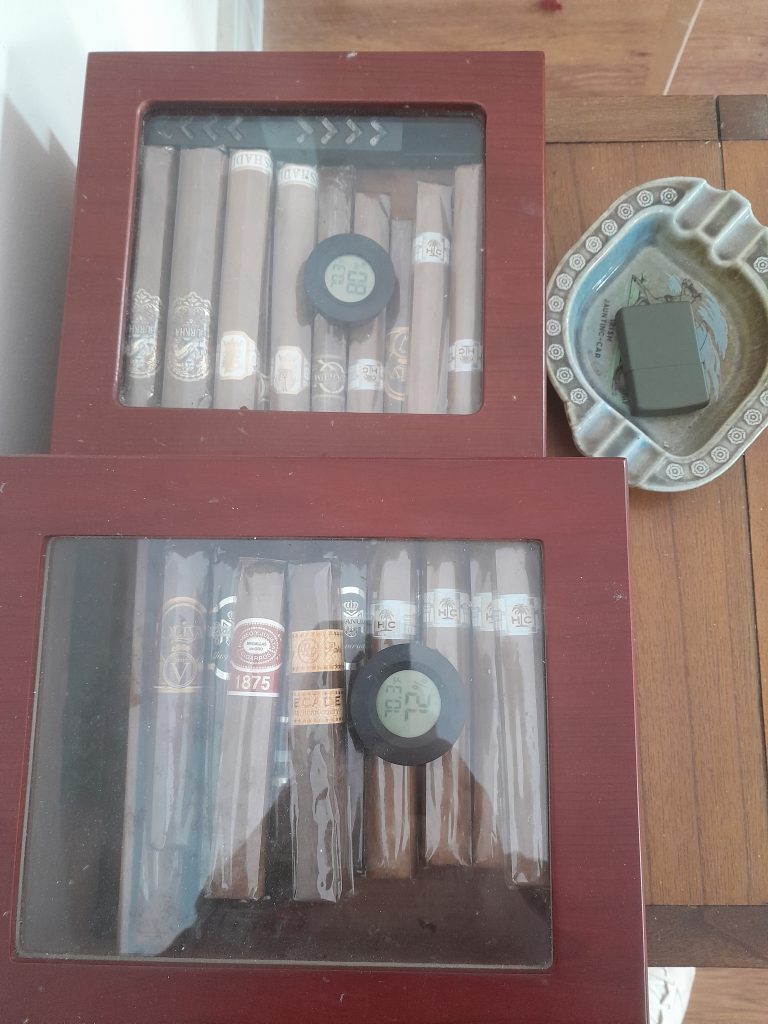
The Humidor – My personal selections

Favorite selections

Wrath by Oliva

Macanudo Inspirado Green

Macanudo Inspirado Black

HC White


On line Cigar stores

Thompson Cigar – They are like Binni’s liquors “If they don’t have it its probably not worth smoking

Cigars international – Good selection great prices and free shipping with no minimum purchase

J.R. Cigars – some occasional nice specials

Famous Cigars – also some occasional good deals


Cigar links

Cigars daily Video’s – Great info on any aspect of Cigar smokers

Cigar Aficionado Blog – Talk about cigars and the people who smoke them

10 Things Every Cigar Smoker Should Know – The basics of premium cigars

Cigar Shapes, Sizes And Colors

The ABCs of Cigars – 26 cigar-industry terms every aficionado needs to know


Rss cigar blog feeds

London Cigar Smoker

  • Celebrating 5 Years of London Cigar Smoker — Plus a Review of 2025’s Best Cigar Events!
    December 27, 2025
  • The Chancery Rosewood to open cigar sampling lounge in partnership with Sautters in 2026
    December 23, 2025
  • A sneak peek behind the scenes of new La Casa del Habano flagship on Pall Mall
    December 18, 2025
  • Corita Cigars ‘Expairing’: Experience Meets Pairing
    December 18, 2025
  • Around the World in 80 Cigars – The American Dream: PCA and Nick Hammond announce landmark literary collaboration
    December 15, 2025

The Stogie Review

  • Cigar Page Bethlehem: Breaking Down the World’s Largest Cigar Store Announcement – Smoke and Steel Episode 022
    December 31, 2025
  • The Best Travel Humidor Options for Cigar Enthusiasts: Episode 021 Breakdown
    December 24, 2025
  • Cigar Industry Tariffs: What 100% Nicaragua Taxes Mean for Your Humidor
    December 17, 2025
  • Christmas Gifts for Cigar Smokers: The Ultimate Holiday Gift Guide
    December 11, 2025
  • Smoke and Steel 019: Winter Cigar Smoking Solutions and Lounge Life
    December 10, 2025

The Cigar Authority

  • JFR 20th Anniversary Super Toro Cigar Review
    January 1, 2026
  • Who Picked the Cigar of the Year? – The After Show
    December 31, 2025
  • The 2025 Cigar Of The Year
    December 27, 2025
  • Announcing The 2025 Cigar of The Year!
    December 26, 2025
  • Rocky Patel Year of the Snake Cigar Review
    December 25, 2025

Cigars Daily

  • New Years for the Cigar Aficionado #cigarsdaily
    December 30, 2025
  • Cigars Daily LIVE 410: 2025 Cigar Year Review + 2026 Spoilers
    December 30, 2025
  • How Cigar Smokers Console Eachother. #cugarsdaily
    December 27, 2025
  • Cigars Daily LIVE 409: How Cigars Cure Christmas Chaos
    December 23, 2025
  • Would you rather: cigar edition. #cigarsdsily
    December 22, 2025

Cigar Shapes, Sizes And Colors

Basic cigar Knowledge by Cigar Aficionado

A primer on cigar shapes, sizes and colors.

| By CA Editors | From Kevin Costner, Nov/Dec 00

Cigar Shapes, Sizes And Colors

One of the missions of Cigar Aficionado has always been to bring cigar lovers together. Between the Big Smokes across the nation and our Internet chat rooms, we’ve done our best to help foster a community of connoisseurs. Through our events, our website and sections such as “Cigar Adviser” in our magazine, we’ve tried to provide aficionados with opportunities to meet others who share their passion, and forums for providing you access to the best, most accurate cigar information possible.

But that’s not enough. Many people read our magazine who may never have thought about smoking a cigar. But the cigar coverage in our pages piques their curiosity, and some of these new readers may become new smokers.

For these novice smokers, and for those who may not have yet discovered cigars, we offer Cigar 101, a crash course in the basics of cigar smoking. This primer will be continued over the course of the next several issues and will highlight a range of cigar topics, from shapes and colors to the proper cutting, lighting and storage for your smokes.

Shapes & Sizes

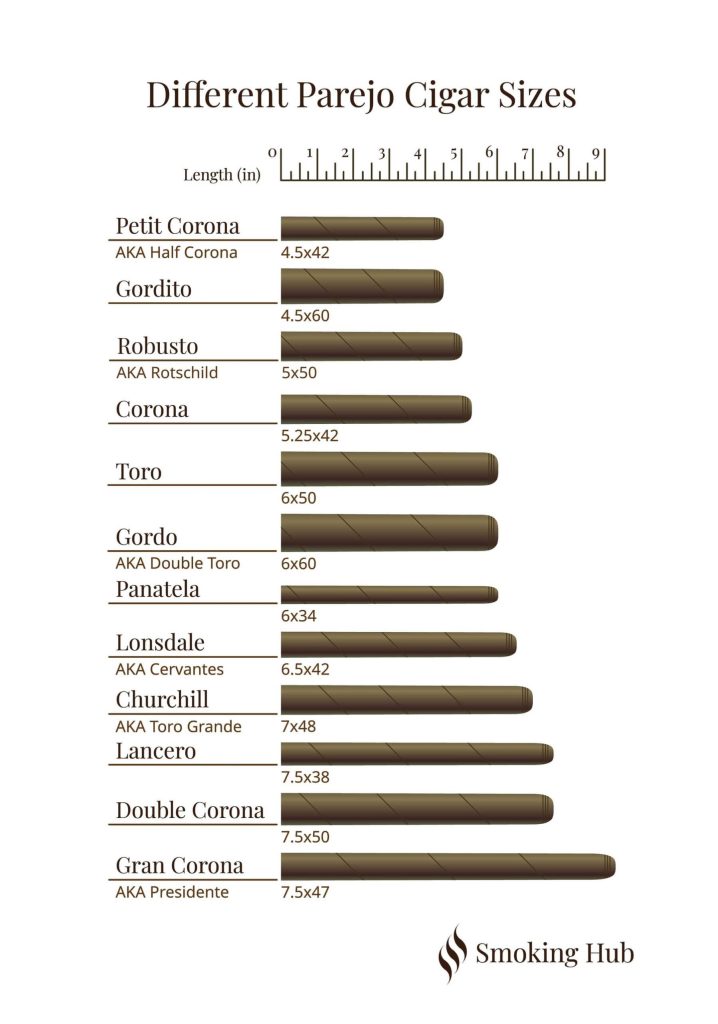
A cigar shape can vary greatly in size from brand to brand, so describing a cigar by its size as well as shape is important. Cigars are measured by two factors: length, which is given in inches, and “ring gauge,” a designation of a cigar’s diameter broken into 64ths of an inch. A cigar with a 42 ring gauge, for example, is 42/64 of an inch in diameter.

There is no correlation between the size of a cigar and its strength. An 8-inch cigar made with mild tobaccos will be mellow, while a thin, short cigar rolled with powerful tobaccos will be full bodied. While a cigar’s strength is determined by the tobacco it is rolled with, thin cigars have a tendency to burn hotter than fatter ones. Also important to note is that there is no consistency of strength from brand to brand: one company’s corona is likely to taste very different from another’s.

Parejos

Parejos are straight-sided cigars; most have an open foot for lighting and need to be cut before smoking. They may be either round or box-pressed, meaning that the sides of the cigar were pressed square prior to packing or, in some cases, by pressure in the box.

Corona

This is the benchmark size against which all other sizes are measured. The traditional dimensions are 5 1/2 to 6 inches with a ring gauge of 42 to 44. Example: Padrón 1964 Anniversary Series Corona Maduro

Padrón 1964 Anniversary Series Corona Maduro

Padrón 1964 Anniversary Series Corona Maduro


Petit Corona

Basically a miniature corona, this cigar generally measures about 4 1/2 inches, with a ring gauge of 40 to 42. Example: Ashton Cabinet Selection Trés Petite

Ashton Cabinet Selection Trés Petite

Ashton Cabinet Selection Trés Petite


Churchill

A large corona format. The standard dimensions are 7 inches by 47 ring gauge. Example: Brick House Churchill

Brick House Churchill

Brick House Churchill


Robusto

A short, fat cigar that has become the most popular cigar size in America. The size is generally 4 3/4 to 5 1/2 inches by 48 to 52 ring gauge. Example: Arturo Fuente Don Carlos Robusto

Arturo Fuente Don Carlos Robusto

Arturo Fuente Don Carlos Robusto


Corona Gorda

Also called a toro, this cigar is steadily growing in popularity. The traditional measurements are 5 5/8 inches by 46 ring gauge, but cigars of 6 inches by 50 ring have also become popular. Example: Oliva Serie V Melanio Maduro Toro

Oliva Serie V Melanio Maduro Toro

Oliva Serie V Melanio Maduro Toro


Double Corona

Double coronas are large smokes, and the standard dimensions are 7 1/2 to 8 1/2 inches by a 49 to 52 ring gauge. You see fewer and fewer in cigar stores nowadays, especially in the non-Cuban cigar world. Example: Hoyo de Monterrey Double Corona

Hoyo de Monterrey Double Corona

Hoyo de Monterrey Double Corona


Panetela

Long and thin, this size’s popularity has decreased in recent years. Still, it is an elegant size, with a wide length variation of 5 to 7 1/2 inches with a ring gauge of 34 to 38, and a good number of panetelas are finished with pigtail caps. Cigars longer than 7 inches in this category are often referred to as “gran panetelas.” The lancero is a subset that is prized among connoisseurs. Example: Cohiba Lancero

Cohiba Lancero

Cohiba Lancero


Lonsdale

A lonsdale is generally longer than a corona but thicker than a panetela, with a classic size of 6 1/2 inches by 42 ring. Example: Montecristo No. 1

Montecristo No. 1

Montecristo No. 1


Grande 

Grandes, the thickest cigar shape, have burst onto the scene since the dawn of the 21st century. These fat cigars, once considered a fad, have found their way onto the portfolio of nearly every major producer of premium cigars outside of Cuba. With ring gauges of 60 and fatter, some even reaching 70 or 80. To be considered a grande, the cigar needs to be a minimum of 4 3/4 inches in length. Example: Rocky Patel Sixty Sixty.

Rocky Patel Sixty Sixty

Rocky Patel Sixty Sixty


Figurados

Although the majority of cigars are parejos, a growing number of cigar companies are broadening their portfolios with more creatively shaped smokes. These cigars are called figurados, and they include any cigar that is not a straight-sided cylinder. Although cigarmakers’ interpretations of the shapes vary as widely as the flavors inside their cigars, the basic categories of figurados are as follows:

Pyramid

Pyramids are cigars with cut feet, like parejos, but with heads tapered to a point. Generally the cigars measure from 6 to 7 inches in length, with ring gauges of about 40 at the head widening to 52 to 54 at the foot. The pyramid is treasured because the tapered head allows the complex flavors of the cigar to meld in the mouth. Example: Montecristo No. 2

Montecristo No. 2

Montecristo No. 2


Belicoso

Traditional belicosos are short pyramids, often with a slightly rounded pyramid head. They often measure from 5 to 5 1/2 inches, with ring gauges of about 50. Today’s belicosos, however, are often coronas or corona gordas with tapered heads. Recent years have also seen the production of mini-belicosos, short cigars with small ring gauges and tapered heads. Example: Bolivar Belicoso Fino

Bolivar Belicoso Fino

Bolivar Belicoso Fino


Torpedo

Torpedoes aren’t as thoroughly classified as many other cigar sizes, and they generally fit into the pyramid category. Generally speaking, cigarmakers use the term torpedo to convey a pyramid with a sharper point. Example: Montecristo 1935 Anniversary Nicaragua No. 2

Montecristo 1935 Anniversary Nicaragua No. 2

Montecristo 1935 Anniversary Nicaragua No. 2


Perfecto

The perfecto has both a tapered foot and a tapered head, typically with a bulge in the middle. Perfectos vary greatly in length, although you see quite a few that are smaller in stature. They also range from the symmetrical, like the pictured Aurora Preferidos, which looks a bit like a bomb, to the more freeform, such as the host of cigars of varying shape in the Arturo Fuente Hemingway series. Example: Aurora Preferidos Gold

Aurora Preferidos Gold

Aurora Preferidos Gold


Culebra

More popular in the past than it is today, the culebra is perhaps the most exotic shape of cigar made. It consists of three panetelas braided together and tied with string, sold as one cigar. The three parts are then unbraided and smoked separately. Usually 5 to 6 inches long, culebras most often have a 38 ring gauge. Since they are difficult to come by today, you might consider sharing the other two braids of the cigar with two friends, turning the smoking of a culebra into a special occasion. Example: Partagas Culebra

Partagás Culebra

Partagás Culebra


Diadema

Diademas are very large figurados, with tapers on both the head and foot, sometimes eight inches or more long. One of the more popular diademas is the Salomone size. All Salomones are diademas, but not not all diademas are Salomones. Example: Cuaba Salomon   

Cuaba Salomon

Cuaba Salomon

Colors

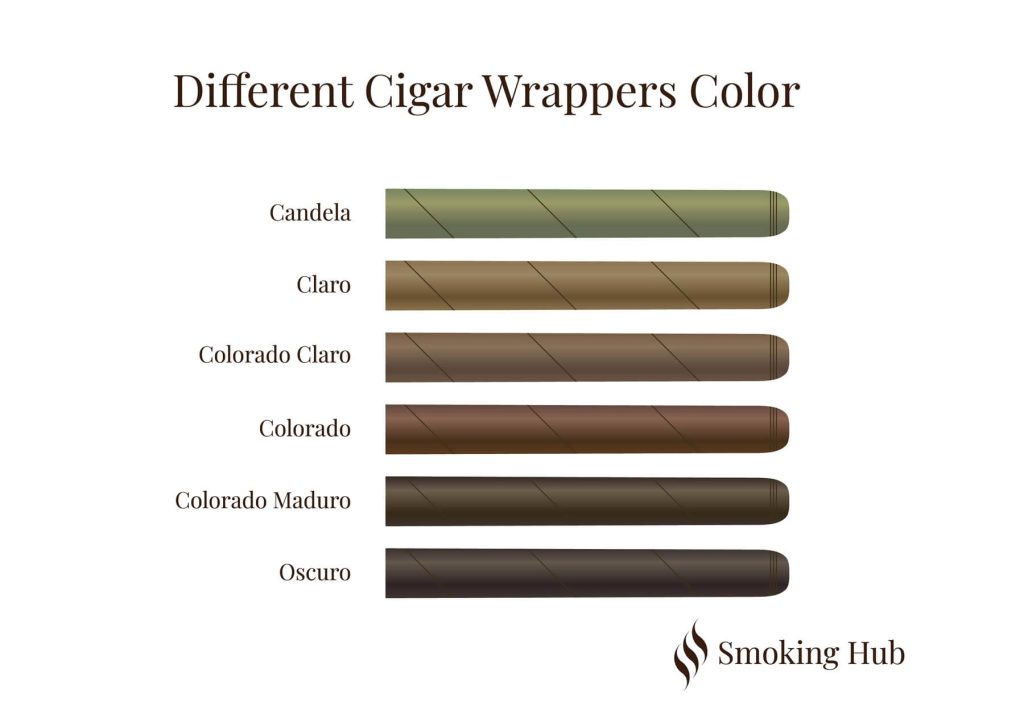
Cigar wrappers come in a wide array of colors, from the palest of greens and yellows to dark black. Just as there are seven basic colors that make up the rainbow, there are seven basic color distinctions among wrappers, with an infinite number of shades between each color. A simple way to begin understanding the color designations is to remember that, just as the state of Colorado is in the middle of the United States, the color “colorado” comes in the center of the color range.

Wrapper leaves vary in color due to the many methods for processing tobacco and the variety of tobacco strains used. Additionally, sunlight can play a factor: a wrapper grown in sunlight is typically darker than a shade-grown wrapper of an equivalent seed strain.

From light to dark, the seven commonly used wrapper color descriptions are:

Double Claro (also called Candela)

Double Claro

This wrapper is light green, a hue created by a quick-drying process using heat that locks in the green chlorophyll of the tobacco. Years ago, this wrapper was tremendously popular in the United States, and it was a point of amusement for Europeans.


Claro

Claro

A light tan color, most commonly achieved by growing in shade under cheesecloth tents, picking the plants early and air-drying the leaves. Flavorwise, these wrappers have little to offer, and allow the flavors of the filler tobaccos to dominate the taste of the cigar.


Colorado Claro

Colorado Claro

Light reddish-brown; often grown in direct sunlight, and given longer to mature before picking.


Colorado

Colorado

The center of the color scale. These cigars are medium-brown to brownish-red and full flavored, though soft and subtle in their aroma. These wrappers are often shade grown.


Colorado Maduro

Colorado Maduro

Darker than colorado, lighter than maduro.


Maduro

Maduro

This shade can vary from a deep reddish-brown to almost black. Maduro means “mature” in Spanish, which refers to longer time needed to cure this color wrapper than wrappers that are lighter. For maduros, leaves are either toasted in a pressure chamber or fermented longer in above-average heat. A maduro wrapper lends significant flavor to a cigar: it tends to be mild in aroma, but to have robust, almost sweet flavor.


Oscuro

Oscuro

This black-as-night wrapper shade is achieved by leaving the leaves on the plant as long as possible, by using only the leaves from the top of the plant, and by fermenting them for an especially long time. Most often Brazilian or Mexican in origin, oscuro wrappers are often very rough, a result of the extra fermentation. This category is sometimes referred to as “black,” “negro” or “double maduro.”


Famous Quotes on Cigars

“I always have a cigar in my hand. It makes me feel relaxed and at home.” – George Burns

“Cigars are a luxury I cannot resist; they remind me of life’s finer pleasures.” – Mark Twain

“it has always been my rule never to smoke when asleep, and never to refrain when awake.” – Mark Twain

“When you smoke a cigar, you’re savoring the richness of life itself.” – Winston Churchill

“I smoke in moderation, only one cigar at a time.” – Mark Twain

“A man can never have too many cigars or books.” – Charles Dickens

“Cigars are a great way to unwind and enjoy the beauty of conversation.” – Victor Hugo

“Life is like a fine cigar—enjoy it fully, one draw at a time.” – Jack London

“A cigar is not just smoke; it represents a story, a memory that you cherish.” – Oscar Wilde

“The only thing better than a good cigar is a good friend to share it with.” – Robert Louis Stevenson

“Cigars can be the perfect conversation starter, transforming silence into dialogues.” – Ernest Hemingway

“I think cigars are just a tremendous addition to the enjoyment of life.” – Rush Limbaugh


Health effects of Cigar smoking

Just a few words about the health aspect of cigar smoking. Some studies show that cigar smokers live longer. George Burns seems to be a great example of that. The bottom line is everything in life has risks. Breathing Radon gas in your basement is a cancer risk, radiation from your cell phone or bluetooth is a a cancer risk, alcohol is a health risk, bacon and eggs are a health risk. Bottom line is is do the research then do what you would feel comfortable with. Personally my comfort level is approximately a cigar or two per week. I have to think anything in moderation has minimal risks to it. It boils down to a balance between personal health concerns and enjoyment of life. Below are some links and videos to help make a decision.

Cigar Smokers live longer – live longer 101

FDA study: Cancer risks nearly nil for 1 to 2 cigars per day

Christmas tide

Remember Christmas tide runs until the Feast of the Pruification of the blessed mother and candlemass.

February 2, 2026

Rss Newsfeeds

Selected Traditional Catholic and Conservative news feeds from around the web

Click Here to go to RSS Newsfeed page.


Brother Albert's Pub

A Traditional Latin Mass Social Network

To visit click HERE or on the picture above


Tridentine Catholic


©2026 Tridentine Catholic | WordPress Theme by SuperbThemes